THE PRIVATE WORLD OF THE GREAT PIANISTS
“Such talent! And such a trivial mind.”
Richter said that about Horowitz.
What the great pianists thought of each other is even more astonishing.
They shared stages, admired recordings, quietly questioned one another—and sometimes left behind devastatingly candid judgments. A documentary eBook for those who have loved the piano for a lifetime.
Richter's remark is quoted in The New Yorker's review of Sviatoslav Richter: Notebooks and Conversations (2001). Historical quotation, not invented dialogue.
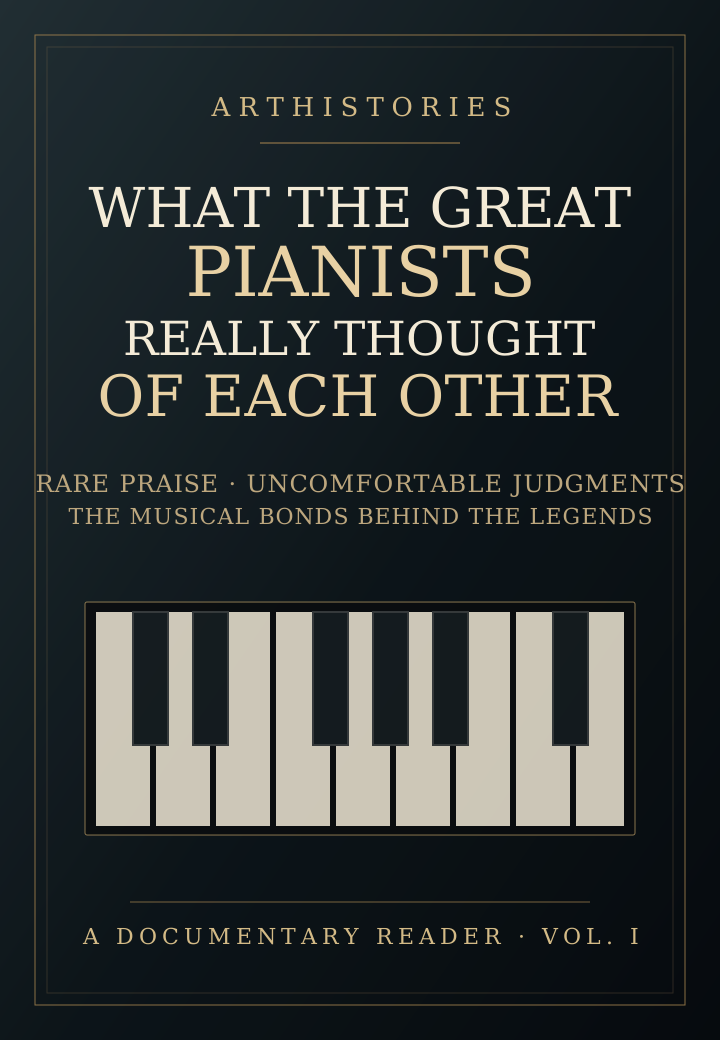
THE ARTHISTORIES READER VOLUME I · DIGITAL EDITION
You know the names. You may have heard their recordings a hundred times.
Richter. Horowitz. Gould. Argerich. Rachmaninoff. Schnabel. Haskil. Lipatti.
Perhaps you still remember the first time you heard one of them. A recital on the radio. An LP taken carefully from its sleeve. A performance that made a familiar passage sound as though it had never been played before.
Most books tell us how the great pianists lived, where they studied, what they recorded and which stages they conquered.
But they leave one extraordinary question unanswered:
Not what a publicity department said. Not who sold the most records. What did one brilliant, exacting musician hear in another's touch, phrasing, courage—or vanity?
Sometimes the answer was admiration so profound that it changed an artistic life. Sometimes it was a friendship expressed in music rather than words. And sometimes the response was an uncomfortable verdict that no concert programme would dare print.
Consider Richter's assessment of Horowitz. He could acknowledge the extraordinary talent and still sharply criticize the musical mind behind it. The distinction tells us more about what musicians value than any simple ranking of the “greatest pianist.”
Or consider the relationship between Glenn Gould and Rosalyn Tureck: the independent young artist recognizing in an earlier Bach interpreter a musical possibility of his own. Or Rachmaninoff hearing a younger Horowitz bring a different kind of power to his Third Concerto.
These are not gossip-column inventions. They are threads in the documented history of the instrument. And when placed beside the recordings, they change how we listen.
That is why we created What the Great Pianists Really Thought of Each Other: twelve carefully written encounters for people who already know the music—and suspect there is much more to discover.
You do not need to read a score. You do not need a conservatory diploma. Just the curiosity that brought you back to the music all these years.
— The ArtHistories editorial team
BEHIND THE FAMILIAR RECORDINGS
Not another list of the “best” pianists.
A glimpse into what greatness heard in greatness.
This book is about respect, disagreement, influence and the private standards behind extraordinary performances.
INSIDE THE FIRST EDITION
Twelve encounters.
Twelve new ways
to hear the masters.
Every chapter brings together an identifiable historical connection, original editorial context, and an invitation to listen with fresh ears.
Read the first chapter freeAlso included: a listening itinerary, further reading, and numbered sources to pursue your own discoveries.
DOCUMENTARY STORYTELLING, NOT INVENTED SCANDAL
A good story can be surprising.
It should also be traceable.
The edition includes numbered references to published interviews, writing by musicians, and established institutions. It separates the historical record from our own listening observations. Readers can return to sources and decide what they hear for themselves.
Works and institutions mentioned are sources of historical information, not sponsors or endorsers of ArtHistories. This is an independently produced reader.
THE AUDIENCE BEHIND ARTHISTORIES
Some listeners have carried these recordings for a lifetime.
Our YouTube documentaries invite discussion among listeners with deep memories of music. The following are real comments on ArtHistories videos, not testimonials from eBook buyers.
“Thank you for a story that brings tears to my eyes.”
“What extraordinary artists! I admire them all”
“That recital is still a favorite, and the Prokofiev, wow.”
AN ARTHISTORIES READER · VOL. ITHE DIGITAL FIRST EDITION
Keep the stories.
Return to the music.
An elegant documentary reader for the listener who wants more than a passing anecdote—and a companion to the records you already love.
- 12 full narrative chapters about musical relationships and judgments
- 36-page English-language PDF, designed for comfortable reading
- A listening invitation in every chapter
- A twelve-stop listening itinerary
- Numbered historical sources and further reading
- A single payment, no membership and no physical shipping
SPECIAL FIRST-EDITION PRICE · ONE-TIME PURCHASE
REGULAR PRICE VS. VERIFIED OFFER
Your ArtHistories digital reader: 12 chapters, listening notes, and a bibliography. One payment, yours to keep.
Checkout powered by Hotmart. Your purchase opens in a new tab; the final total and payment terms are shown there.
Read the complimentary sample first ↗FOR THE SERIOUS LISTENER
More than an afternoon read.
A companion to the recordings.
Return to these musical encounters whenever you revisit a cherished recording. The best moments of history do not grow old: they offer a new way to hear a familiar phrase, a surprising choice, or an unexpected artistic friendship.
This edition gives you a single digital book to keep, annotate, and revisit at your own pace.
FREQUENTLY ASKED
Before you begin reading.
Is this a guide to learning the piano?
No. It is a narrative historical reader for people curious about the greatest interpreters and their musical relationships.
Must I read music to enjoy it?
Not at all. This book was written for attentive music lovers, including listeners who have never played an instrument.
Are the historical remarks documented?
The book includes numbered references and further reading. Editorial listening observations are differentiated from documented historical statements.
What exactly will I receive?
A 36-page English PDF with twelve chapters, a listening itinerary and sources. No audio files, scores, printed copies or recurring subscription.
How is the book delivered?
Once the Hotmart product and payment link are activated, the PDF is provided through the digital delivery process after purchase.
What about refunds and purchase support?
Applicable refund and support terms will be displayed by Hotmart at checkout when the product is activated.